




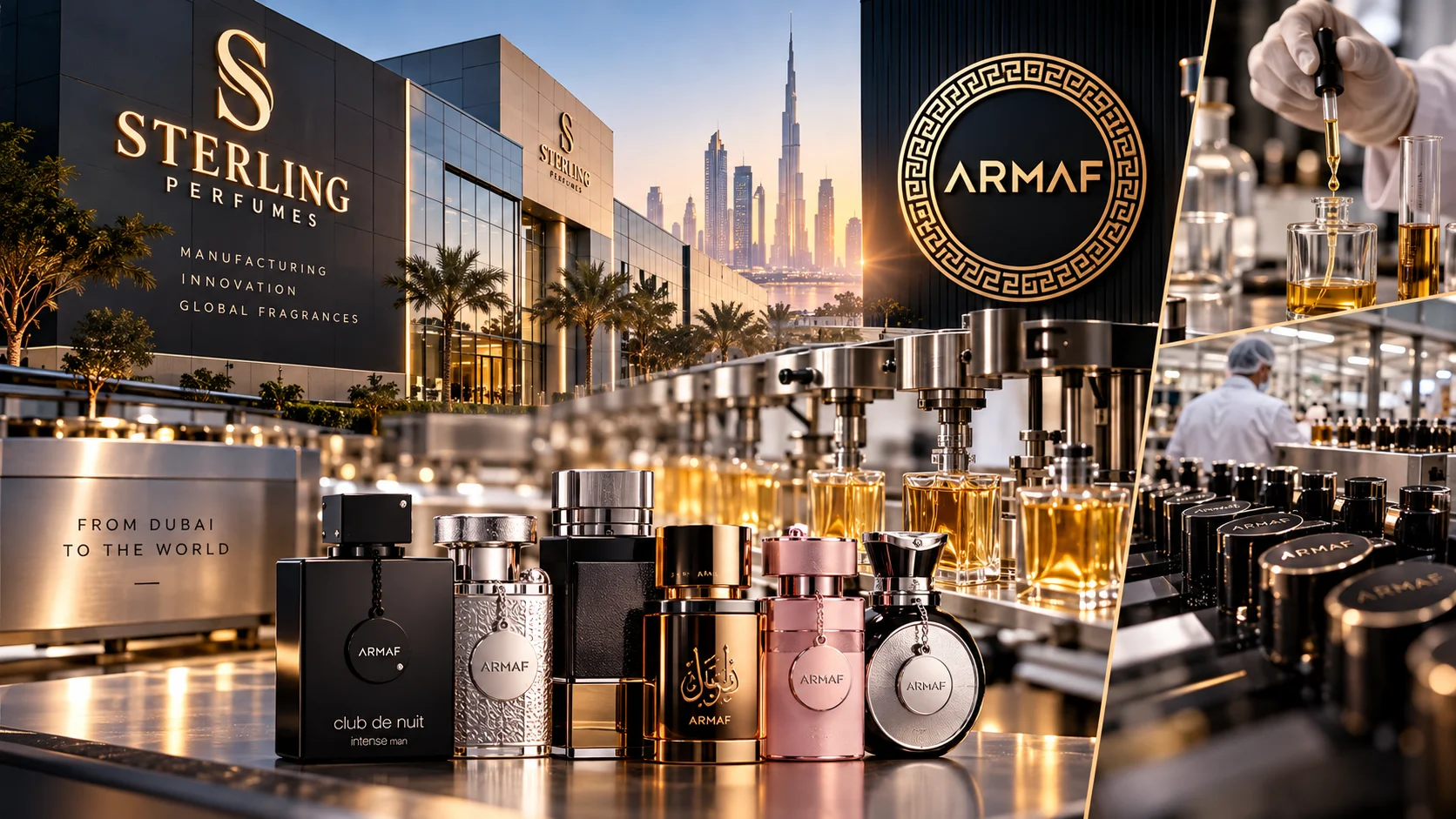
When an Armaf fragrance appears on a shelf in Brazil, Europe or the United States, consumers see a brand. Behind that bottle, however, there is a much larger industrial operation: Sterling Perfumes Industries, a UAE-based structure that helps explain how Armaf has managed to grow with such speed and international reach.
Understanding this relationship matters because much of the coverage of Arab perfumery still focuses only on the final product. The bottle, notes, inspiration and social-media hype receive attention. Much less is said about who manufactures, develops, distributes and sustains the expansion.
In Armaf’s case, that infrastructure is an essential part of the story.
From 250 pieces a day to industrial scale
In Armaf/Sterling’s own institutional presentation, the group says its manufacturing operation began at around 250 pieces per day. Today, the company says it has capacity approaching 250,000 pieces daily.
The gap between those figures illustrates the transformation.
Perfume may be sold as art and emotion, but once a brand reaches dozens of markets it also becomes a problem of engineering, procurement, packaging, quality, inventory and logistics.
Every increase in demand needs to be matched by production capacity. Otherwise, virality quickly turns into shortages, delays and lost distributors.
Armaf is the best-known face of a larger structure
For many international consumers, Sterling is a less familiar name than Armaf. That is normal: industrial groups often remain behind the brands they sell.
But the strategy becomes clearer when Armaf’s recent expansion is considered.
In Cannes during TFWA 2026, Sterling executives told TRBusiness that the brand is already available in approximately 140 countries and still sees considerable room for growth.
That international presence would not be viable without production and distribution systems capable of keeping up with demand.
The growth of Arab perfumery is not only a TikTok phenomenon
Social media played an enormous role in the discovery of Middle Eastern fragrances. Videos about value for money, strong performance, dupes, gourmands and striking packaging helped Emirati brands reach audiences that might never have encountered them through traditional retail.
But it is a mistake to attribute the entire expansion to virality.
TikTok can create demand. It does not manufacture 250,000 units a day, coordinate exports to dozens of countries or establish relationships with duty-free operators.
Growth is sustainable only when industrial infrastructure can convert attention into availability.
Competitive pricing also depends on scale
Another element frequently associated with Arab brands is price.
Many consumers discovered Armaf and other Gulf houses because they found elaborate presentation at prices below major designer brands.
Industrial scale helps make that positioning possible.
Producing large volumes, negotiating components in quantity and centralizing processes can reduce unit costs. That does not mean every mass-produced perfume is inexpensive, but it helps explain how some brands can compete aggressively without operating like small ateliers.
Travel retail shows the maturity of the operation
Armaf’s deeper move into airports and duty free also highlights Sterling’s role.
Travel retail requires formats, packaging, logistics and planning that differ from conventional retail. A brand needs to serve international operators, adapt kits, develop miniatures and manage channel-specific requirements.
Sterling is already working with refillable versions, travel sets, discovery sets and products designed specifically for airports.
This shows a company that is not simply exporting the same catalog everywhere.
Distribution is as important as creation
In perfumery, there is a tendency to value the creative moment almost exclusively. Who is the perfumer? Which raw materials were used? What was the inspiration?
Those questions matter, but they represent only one part of the business.
A fragrance can be excellent and remain irrelevant if it never finds distribution.
On the other hand, a company that masters manufacturing and logistics can test products, expand quickly and respond to trends at greater speed.
That is one reason conglomerates and large manufacturers have so much influence over the sector.
Dubai as an industrial platform
Being based in the Emirates also supports an international strategy.
Dubai functions as a logistics hub between Asia, Europe, Africa and the Middle East. Its trade and distribution environment makes it easier to build global networks, especially for companies that are export-oriented from the beginning.
The local fragrance industry has benefited from this ecosystem.
The result is a generation of brands that can develop product in the Emirates, manufacture at scale and distribute simultaneously to culturally very different markets.
What changes when we look at the manufacturer
For consumers, knowing who is behind a brand helps explain positioning and capability.
For retailers and distributors, it matters even more. Commercial relationships depend on stock, consistent quality, replenishment, support and predictability.
As a company like Sterling grows, it increases the ability of its brands to occupy space in global retail.
The next phase of Arab fragrance houses
The first major international wave of Arab perfumery was based on discovery: consumers finding unfamiliar names, competitive prices and intense styles.
The next phase will probably be about consolidation.
That means building durable franchises, developing proprietary channels and investing in boutiques, travel retail, collaborations and consistent visual identity.
At this stage, manufacturers and business groups become even more important.
Sterling Perfumes helps show that behind the exuberant aesthetics of many Dubai fragrances there is an industry maturing rapidly.
To understand the future of Arab perfumery, therefore, it is not enough to follow the brands alone. It is also necessary to follow the companies capable of taking them to global scale.