






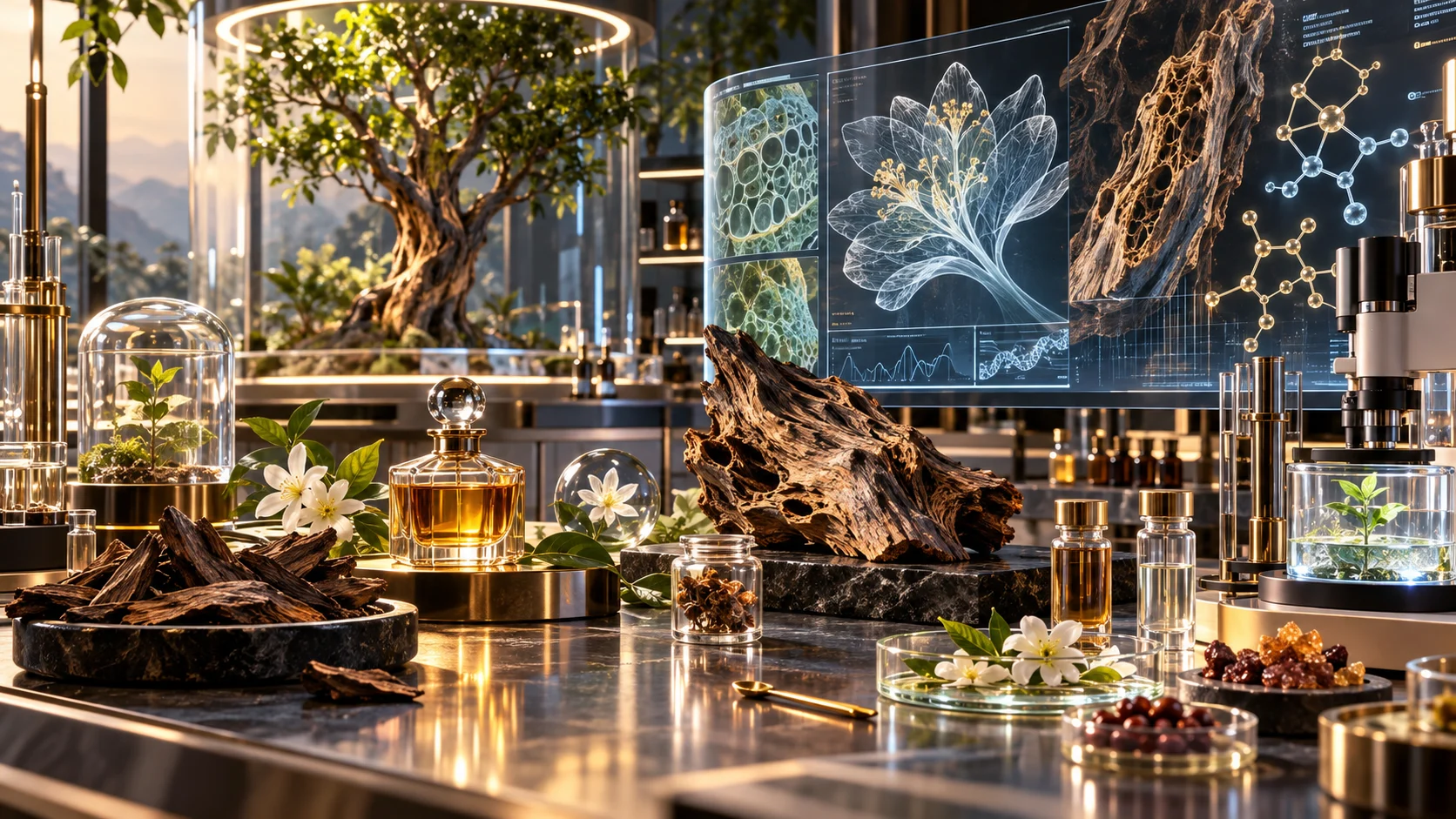
For centuries, perfumery has depended directly on nature for some of its most valuable raw materials. Flowers, roots, resins, woods, leaves and seeds have shaped some of the most important signatures in the history of fragrance. The problem is that luxury, scarcity and growing demand do not always form a sustainable combination.
Now, a new technological frontier is beginning to gain ground in this debate. Artificial intelligence, molecular analysis, plant-cell culture and systems capable of predicting how molecules smell are being used to try to produce rare aromas and compounds without continuously removing material from nature.
An investigation published by The Guardian on October 6 showed how companies such as Osmo and BioHarvest Sciences are approaching the problem from different directions. The idea sounds almost futuristic: understand a scent at the molecular level, reconstruct it in the laboratory, or produce a plant’s own compounds through its cells, so that every new production cycle does not depend on cultivating or harvesting the original species.
The technology is promising. But there is a fundamental difference between reproducing the smell of a plant and saving the plant that produces that smell. That distinction sits at the center of one of the most important discussions about the future of perfumery.
When scent starts becoming data
Osmo emerged from research carried out at Google Brain on artificial intelligence applied to olfaction. Its goal is ambitious: teach computers to connect the chemical structure of a molecule with what humans perceive as smell.
Color can be organized through mathematical systems and sound can be described through frequencies, but olfaction is far more complex. Small changes in a molecule’s structure can produce major changes in odor perception, while the human response involves hundreds of different types of olfactory receptors.
Researchers associated with Osmo developed what they call the Principal Odor Map, an artificial-intelligence model that organizes molecules inside a multidimensional space and attempts to predict their olfactory characteristics. The technology grew out of an effort to turn smell into computable information and, from there, reduce the chemical universe that researchers and perfumers need to explore experimentally.
This does not eliminate the perfumer. Quite the opposite. Sensory evaluation, creative direction and artistic construction remain human. The change lies in using machines as tools to identify patterns and candidates that would be extremely difficult to investigate one by one.
Can a scent be “digitized”?
Osmo is also working on a concept called Scent Teleportation. The name sounds like science fiction, but the principle is relatively clear: capture an aroma, separate and analyze its volatile components, transform those data into a computational representation, and then attempt to physically reconstruct the olfactory experience.
One technique involved in this process is gas chromatography coupled with mass spectrometry, known as GC-MS. It helps separate and identify compounds present in an aromatic sample. Computational models can then assist in interpreting the results and formulating a reconstruction.
Osmo has already demonstrated the concept in the laboratory with real materials. The company described an experiment with coconut as one of its first examples of capturing, analyzing and reconstructing a smell. The Guardian report also notes that the company worked with a small bark sample from a rare tree to study and reproduce its aromatic profile.
This possibility changes a historic question for the industry. Instead of thinking only about how to extract more from a rare raw material, it becomes possible to ask whether part of its olfactory signature can be understood and reproduced with far less pressure on the natural source.
BioHarvest takes a different route
BioHarvest Sciences is tackling the problem from another angle. Rather than reconstructing an odor from available molecules, the company uses a Botanical Synthesis platform focused on growing plant cells in controlled environments.
In March 2026, BioHarvest announced that it had created a stable cell culture from a rare and endangered plant used by the fragrance industry. The identity of the species was not disclosed because the project is protected by a confidentiality agreement.
This detail needs to be handled carefully: there is not enough public evidence to claim that the plant involved is Aquilaria or that the material is specifically oud. What the company has stated is that it is an extremely valuable raw material derived from an endangered plant and relevant to luxury perfumery.
The cell cultures contained compounds such as sesquiterpenes and chromones, molecular classes associated with depth, persistence and complexity in different aromatic materials. The proposal is to select cells capable of producing the desired compounds and multiply them under controlled conditions without having to grow the entire plant for each production cycle.
From the laboratory to a possible industrial supply chain
BioHarvest’s story deserves attention because it moved quickly during 2026. In May, the company signed a US$1.2 million contract to advance to the second stage of development and produce enough material for commercial testing.
In August came an even more significant signal: the company announced a manufacturing and supply agreement that provides capacity for up to 20 metric tons of material during 2027 and 2028. According to the company, if technical and commercial targets are met, the agreement could represent between US$20 million and US$30 million in revenue.
This does not mean the technology is already replacing natural raw materials in the global market. It means something more precise: the concept is moving beyond scientific demonstration and toward a real attempt at industrial-scale production. That point separates a laboratory curiosity from something that could eventually alter a supply chain.
Why oud appears so often in this discussion
Although BioHarvest has not disclosed which plant it is using, any discussion of threatened fragrance raw materials inevitably leads to agarwood, known in perfumery as oud.
Agarwood is an intensely aromatic resinous wood formed mainly by trees of the genera Aquilaria and Gyrinops. The resin develops as a response to injury, infection and other forms of stress, and it can generate a raw material of enormous cultural, religious and commercial value.
Historical pressure on wild populations led Aquilaria and Gyrinops to be included in Appendix II of CITES, which regulates international trade in threatened species. Convention documents record decades of exploitation and the challenges of sustainable management in different parts of Asia.
There is also a particular factor that makes the chain more complex: not every tree produces high-quality agarwood. In wild populations, valuable resinous wood may occur only in a limited share of trees, which has historically encouraged cutting and searching practices with major environmental impacts.
That is why oud has become such a strong symbol of this discussion. The ingredient combines tradition, luxury, scarcity, enormous economic value and an environmentally sensitive supply chain.
Can technology replace natural oud?
The answer requires separating two ideas. One thing is to reproduce certain olfactory aspects. Another is to completely replace a natural raw material.
A natural ingredient may contain dozens or hundreds of compounds in proportions influenced by species, soil, climate, age, stress, fermentation, extraction method and storage. Even when technology identifies molecules central to a certain signature, reproducing the full sensory complexity of a natural material remains difficult.
In addition, perfumery is not only chemistry. Origin, terroir, history, production method and cultural identity also influence the value of particular materials. A technological reconstruction may reproduce part of the olfactory experience without reproducing everything the material represents.
Something similar already happens with other ingredients. Synthetic molecules did not eliminate natural rose from perfumery, and vanillin did not make natural vanilla irrelevant. Natural and laboratory-made materials often coexist because they serve different purposes in creation.
The biggest risk is turning technology into an excuse
Experts interviewed by The Guardian emphasize an essential point: producing a laboratory alternative does not automatically conserve a forest. If demand for the natural product remains high, wild populations may continue to be under pressure even when a technological alternative exists.
Conservation depends on enforcement, sustainable management, traceability, responsible cultivation, habitat restoration and appropriate economic incentives for the communities involved. Artificial intelligence does not replace any of these measures.
There is also a communication risk. Words such as “sustainable,” “natural” and “saving species” can be used far more broadly than the available data justify. Technology should therefore be analyzed as a tool capable of reducing part of the pressure on certain raw materials, not as an automatic solution to biodiversity loss.
The impact could go far beyond endangered species
If these technologies work at scale, their potential effect is not limited to ingredients at risk of extinction. The industry could use them to deal with raw materials that suffer from strong crop variation, limited geographic availability, volatile prices or production difficulties.
A raw material repeatedly affected by drought, agricultural disease or climate change could, in some cases, gain a second supply route. For brands and fragrance houses, that could mean greater predictability. For perfumers, it could mean more consistent access to certain aromatic profiles.
But this change also raises a delicate economic question: how can technological innovation avoid stripping value from communities that have historically cultivated, harvested or processed these raw materials?
The sustainable future of perfumery will not be decided only in laboratories. It will also depend on how economic value is distributed along the chain.
AI could also accelerate the discovery of new molecules
Artificial intelligence goes beyond reproducing natural materials. Computational models can be used to explore molecules that have not yet been synthesized and predict olfactory characteristics before each candidate is physically produced.
This could shorten one of the most time-consuming stages of ingredient development. Instead of synthesizing thousands of possibilities with no prior indication, researchers can use models to prioritize structures with a greater probability of delivering a desired profile.
The machine does not decide what is beautiful, elegant or emotionally compelling. It narrows the search space. Scientists and perfumers remain responsible for deciding what is truly worth developing.
The human nose remains at the center
All this technology creates an interesting irony: the more sophisticated systems become at studying smell, the clearer the value of human perception becomes.
A machine can analyze molecules, recognize patterns and suggest structures. But perfume is not judged only by chemical accuracy. It needs to create contrast, memory, evolution on the skin and a coherent aesthetic experience.
The most likely transformation, therefore, is not a perfumery made by computers without perfumers. It is a perfumery in which perfumers have much more powerful scientific tools at their disposal.
The next revolution may happen before the bottle
When we think about innovation in perfumery, we usually imagine a new ingredient, a different bottle or a fragrance built around an unexpected note. Yet some of the biggest changes happen long before consumers encounter any perfume on a shelf.
The ability to grow cells from a rare plant without growing the entire plant, models capable of predicting odor from chemical structure, and systems that turn aromas into data could change what perfumers have available to create with over the coming decades.
Important questions remain about cost, olfactory fidelity, regulation, consumer acceptance and real environmental impact. It will also be necessary to see whether biotechnology-derived materials can reach scale without generating other significant environmental costs.
It would be premature to announce that artificial intelligence has “saved” any species. But ignoring what is happening would be equally misguided. Perfumery is entering a phase in which nature, biology and computation are beginning to meet inside the same creative chain.
Perhaps an important part of the future of fragrance will not simply be discovering new plants to harvest. It may be learning to understand, with far greater precision, what makes each of them smell the way it does.
Sources
The Guardian — Making scents: could AI help perfumers take pressure off endangered plants?
Osmo — How we invented scent teleportation
BioHarvest Sciences — stable cell culture development for a rare fragrance-producing plant
BioHarvest Sciences — 20-ton manufacturing and supply agreement
CITES — medicinal and aromatic plants / agarwood-producing taxa