






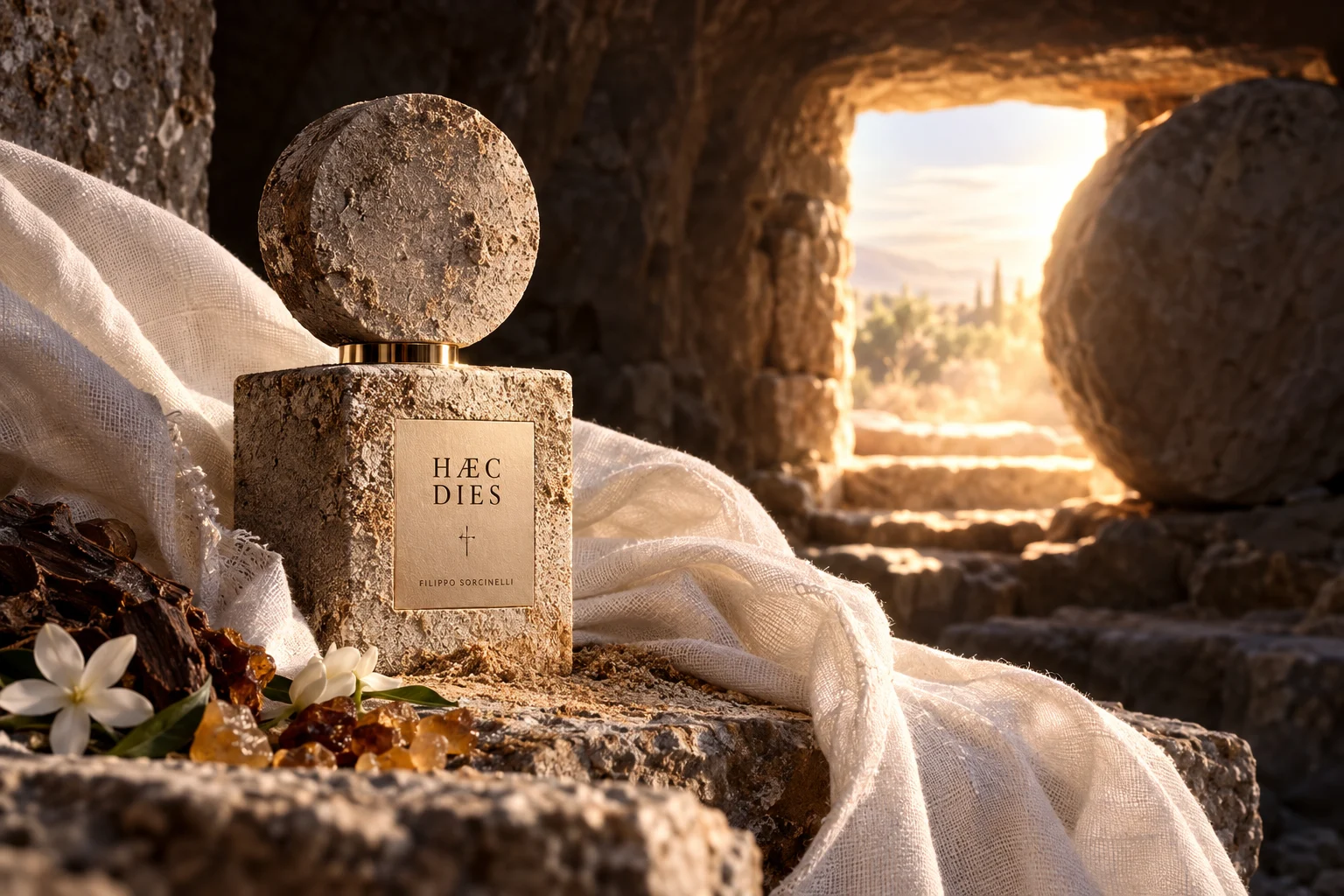
Discover HÆC DIES by Filippo Sorcinelli, a fragrance inspired by the Resurrection of Christ that transforms myrrh, aloe, linen and the empty tomb into olfactory art.
On the morning when they expected to find a body, they found an empty tomb. The women had gone there carrying aromatics intended for the body of Jesus, but the large stone sealing the entrance had already been removed. It is precisely from this moment — marked by astonishment and by the transformation of what had seemed definitive — that Italian perfumer Filippo Sorcinelli begins to create HÆC DIES.
Launched in 2023 as part of the Délire de Voyage collection, the fragrance is presented as an Extrait de Parfum and goes far beyond a composition merely inspired by religious elements. Sorcinelli built a project in which perfume, packaging, raw materials and narrative work together. Myrrh, aloe, linen, sand and even the bottle’s enormous circular cap all take on meaning within the work.
The story behind HÆC DIES
The brand itself identifies the Gospel of Mark as one of the main references for HÆC DIES. In Mark 16, Mary Magdalene, Mary the mother of James, and Salome buy spices in order to anoint the body of Jesus. On the way, they wonder who will roll away the great stone from the entrance to the tomb, but when they arrive they find that the stone has already been moved and are told that Jesus has risen.
Sorcinelli transforms this moment into an artistic interpretation. In his narrative, the vessel containing the precious aromatics intended for the body falls to the ground and breaks before the empty tomb. The perfume spreads through a space that should have represented death, but where there is no longer a body to anoint. The original purpose of those aromatics disappears and acquires another meaning.
An important distinction needs to be made: the image of the broken vessel is Sorcinelli’s artistic elaboration, not a literal description from the biblical text. What makes HÆC DIES interesting is precisely its ability to use a historical and religious episode as a starting point for creating its own olfactory language.
Myrrh, aloe and the empty tomb
Although Mark is the central reference for the discovery of the empty tomb, other elements used in HÆC DIES are directly connected to the burial account in the Gospel of John. In John 19, Nicodemus brings a mixture of myrrh and aloes for the preparation of Jesus’s body, which is then wrapped in linen cloths together with the spices.
This relationship helps explain why materials such as myrrh, aloe and linen do not appear in the project merely for aesthetic reasons. They act as points of connection between the fragrance and the story that inspires it. Myrrh stops being only a resinous raw material commonly used in perfumery and begins to carry a specific historical and symbolic context.
The combination of references to the burial and to the later discovery of the empty tomb creates the narrative arc of HÆC DIES. Conceptually, the fragrance begins in a ritual intended for death but ends with the absence of that body and with the idea of transformation.
What does HÆC DIES smell like?
The composition also moves away from the traditional top, heart and base presentation. Sorcinelli uses terminology closer to music, organizing the fragrance into subject, countersubject and coda. The coda brings together aloe vera, bergamot, orange and jasmine; the countersubject features cedar, peach, rose and myrrh; while the subject is formed by vanilla, sandalwood, patchouli, amber and musk.
The result places citrus freshness, green nuances, flowers, fruits, resins and a warmer, more enveloping base side by side. Myrrh holds a particularly important position because it connects the olfactory composition with the story that inspired the work.
In a conceptual fragrance such as HÆC DIES, however, analyzing only the list of notes would be insufficient. The materials were selected to create scent, but also to sustain a narrative. It is this combination of olfactory function and meaning that separates the perfume from a simple thematic composition.
The bottle also tells the story
The narrative continues in the physical presentation. The bottle has a surface that evokes sand and dust, creating a visual connection with the path and with the imagined environment surrounding the tomb. The enormous circular cap — perhaps the most striking visual element of HÆC DIES — stylistically represents the stone that sealed the tomb’s entrance.
When the cap is removed, there is almost a symbolic repetition of the central gesture in the narrative: the stone no longer occupies its original position. It is an example of how design can go beyond purely decorative function and actively participate in the construction of meaning in a perfume.
White linen is also part of the presentation and reinforces the reference to the cloths used in the funerary context described in the biblical texts. Bottle, texture, cap and fabric therefore form a single artistic project. None of these elements was conceived entirely independently.
Who is Filippo Sorcinelli?
This relationship with liturgy did not emerge only for HÆC DIES. Long before developing his perfume brand, Filippo Sorcinelli already worked directly with art and liturgical vestments. In 2001 he founded LAVS — L’atelier vesti sacre, dedicated to creating religious vestments, objects and accessories.
According to the company itself, the atelier collaborated with the Office for the Liturgical Celebrations of the Supreme Pontiff and produced work used during the pontificate of Benedict XVI, while also taking part in the production of vestments connected to the inaugural Mass of Pope Francis’s pontificate in 2013.
Sorcinelli’s perfume house emerged later and began incorporating elements of music, architecture, photography, memory, religion and art. This background is fundamental to understanding HÆC DIES. Christian references do not appear as an isolated theme created simply to attract attention, but as part of an artistic universe that has accompanied the creator for years.
The meaning of the name HÆC DIES
The name is also part of this construction. Hæc dies comes from the Latin expression Hæc dies quam fecit Dominus, traditionally translated as “This is the day the Lord has made.” The phrase appears in Psalm 118 and holds an important place in the liturgical tradition of Easter.
The choice reinforces the idea that HÆC DIES does not seek to represent simply death, burial or religious elements associated with incense and myrrh. Its central inspiration lies in the passage from one state to another: from the closed tomb to the open tomb, from the presence of the body to its absence and, within Christian tradition, from death to Resurrection.
It is precisely this transformation that gives coherence to the concept of the fragrance.
When perfume stops representing only a smell
HÆC DIES demonstrates a particularly interesting possibility within niche perfumery: using perfume as a medium for storytelling. Instead of limiting communication to seduction, luxury or an olfactory pyramid, Sorcinelli works with symbols, objects, raw materials and historical references.
Myrrh is not just a note. Linen is not just packaging. Sand does not function only as texture. The cap is not simply an extravagant closure. All these elements participate in the same narrative and help turn the fragrance into an experience that goes beyond smell on skin.
Technically, HÆC DIES remains an Extrait de Parfum. Commercially, it belongs to the world of niche perfumery. Artistically, however, it operates almost like a miniature installation: an object whose understanding depends as much on its scent as on the story that surrounds it.
Perhaps this is the most interesting aspect of Filippo Sorcinelli’s creation. Even before asking whether HÆC DIES pleases the nose, the fragrance poses another question: how far can perfume go when it stops trying merely to smell good and begins trying to represent an idea?
Technical details
Perfume: HÆC DIES
Brand: Filippo Sorcinelli
Collection: Délire de Voyage
Year: 2023
Concentration: Extrait de Parfum
Volume: 100 ml
Creator: Filippo Sorcinelli
Coda: Aloe vera, bergamot, orange and jasmine
Countersubject: Cedar, peach, rose and myrrh
Subject: Vanilla, sandalwood, patchouli, amber and musk
Sources consulted: the official HÆC DIES page and official Filippo Sorcinelli biography; the Gospel according to Mark, chapter 16; the Gospel according to John, chapter 19; and Holy See liturgical references connected to the expression Hæc dies quam fecit Dominus.