






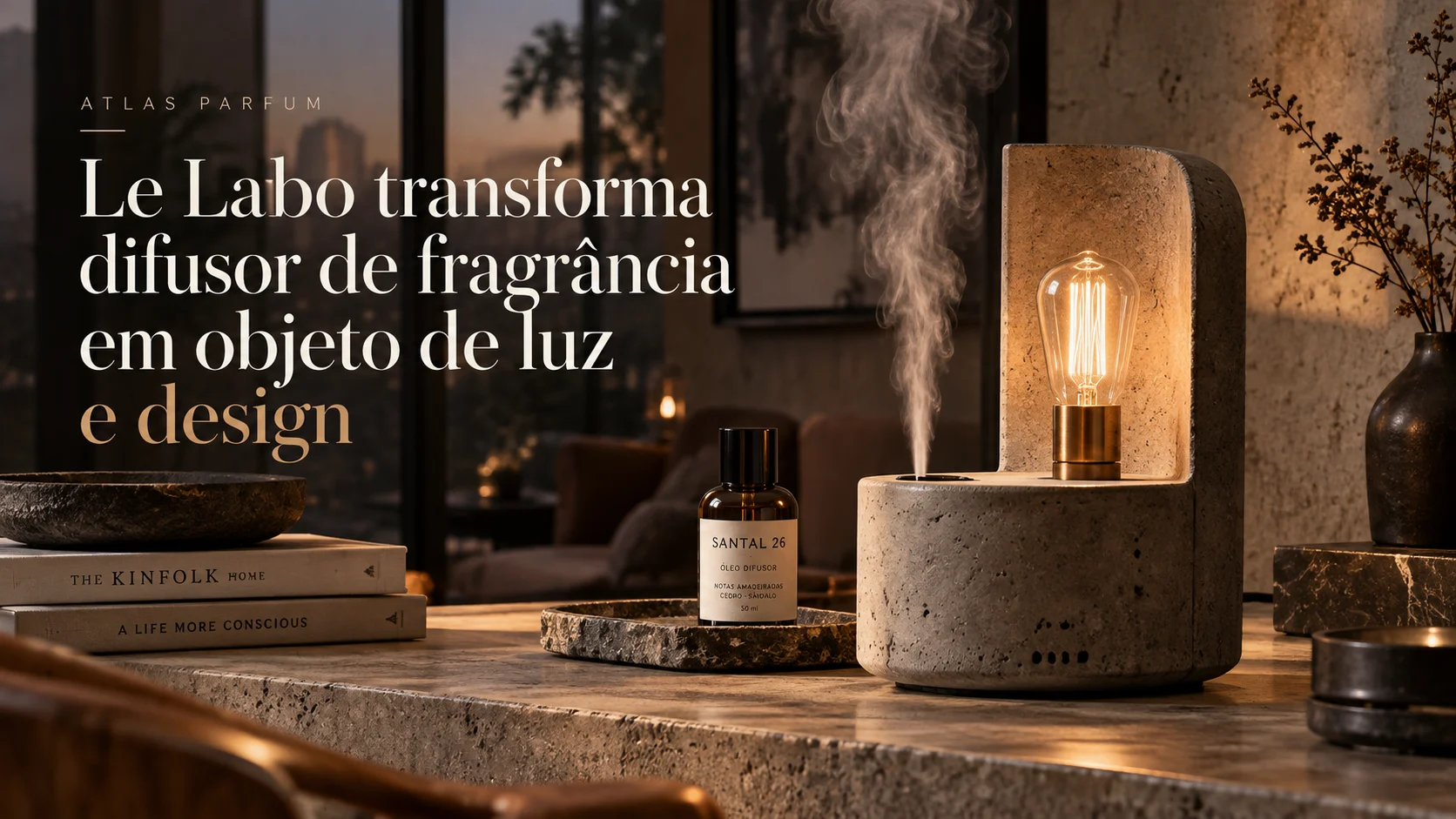
Le Labo is turning a functional home-fragrance device into a design object. The new Concrete Home Diffuser, introduced on October 5, 2026, moves away from the more artisanal look of the brand’s previous wooden versions and adopts a hand-cast concrete base, combined with a nebulizer and an Edison bulb whose light responds visually to the intensity of the fragrance diffusion.
It may look like a small change at first, but the product shows how the home-fragrance market is no longer competing only through scent. It is beginning to compete for space within architecture, lighting and interior design as well.
When the diffuser stops trying to disappear
For years, many home-fragrance devices were designed to be discreet. Reeds, electric devices and nebulizers were expected to do their job without necessarily becoming visual focal points.
The Concrete Home Diffuser does the opposite. Its heavy concrete base, with natural color variation and small imperfections in the material, was designed to remain visible. According to the launch presentation published by Hypebeast, each unit is cast, polished and sealed by hand in the United States, meaning no two pieces are exactly alike.
The idea of patina also matters. Concrete naturally records signs of time and use, bringing the object closer to furniture or collectible design than to a piece of electronics meant to be replaced as soon as a newer version appears.
The fragrance is nebulized, not heated
Inside the structure is a nebulization system designed to turn perfumed oil into an extremely fine mist. This method differs from devices that use water or heat to disperse fragrance.
Le Labo already used this principle in its earlier diffusers. The brand explains that the Santal 26 oil used in these devices has a texture and concentration specifically formulated for nebulization.
In practice, the goal is to distribute the fragrance without diluting it in water and without exposing it to heat. For a brand whose value is strongly tied to the perceived quality of its olfactory materials, the technology is not just a technical feature: it is part of the positioning.
A light bulb that reacts to scent
The most unusual element of the new device is the integration of an Edison bulb. The brightness increases and decreases in sync with the fragrance diffusion level.
This creates a visual translation of something that is normally invisible. Consumers cannot see aromatic molecules moving through a room, but they can now perceive the system’s activity through light.
The feature turns two stimuli — scent and lighting — into a single experience. Rather than the diffuser simply perfuming while a lamp happens to illuminate, the two behaviors are synchronized.
Santal 26 remains the olfactory centerpiece
The set includes Santal 26 diffuser oil, one of the most recognizable signatures in Le Labo’s home-fragrance line.
The choice is coherent. By launching a device with such a strong visual language, the brand reduces the need to introduce a completely new olfactory identity at the same time. Consumers who already know Santal 26 can focus their attention on the new format.
This principle appears frequently in luxury: an established property acts as an anchor while the brand experiments in another dimension of the product.
From home fragrance to interior object
The most interesting part of the launch is the category it tries to occupy. Is it a diffuser, a lamp or a decorative object?
In practice, it tries to be all three.
That mixture makes sense in a market where the boundaries between perfumery, decoration and lifestyle are becoming increasingly blurred. Luxury candles are already chosen as much for their vessels as for their scents. Perfume bottles function as collectible objects. Diffusers are beginning to follow the same path.
In this context, the home is no longer just a place where fragrance is applied. It becomes an extension of the consumer’s olfactory identity.
Concrete fits Le Labo’s visual language
The use of concrete does not seem accidental either. Le Labo has built an identity around exposed materials, utilitarian labels, glass, metal, wood and surfaces that avoid excessive ornamentation.
A device made from polished glossy plastic could work technically, but it would not communicate the same message. Concrete reinforces an industrial, almost architectural aesthetic and turns the small irregularities of production into part of the luxury proposition.
It is a different vision of classical luxury, which tends to seek perfectly finished surfaces. Here, individuality comes precisely from the trace of the process.
Home fragrance is becoming more sophisticated
The home-fragrance market spent a long time divided between functional mass-market solutions and premium candles. Today there is an increasingly sophisticated middle ground: diffusion machines, connected systems, concentrated oils, refillable devices and objects designed to remain integrated into the home.
The Concrete Home Diffuser shows how fragrance brands can capture more value in this segment without simply launching another scent.
Instead of competing only through formula, Le Labo turns the diffusion method itself into part of the experience.
What this launch says about the future
There is a broader reading behind the product. As consumers invest more in transforming their homes into personal, sensory spaces, fragrance begins to participate in interior design in much the same way as lighting, texture and sound.
That opens the door to a generation of hybrid objects in which technology and scent work together.
Le Labo’s new diffuser may not represent a technological revolution on its own. Its importance lies in showing that the device used to release fragrance can itself become part of the desire.
The evolution of home fragrance, therefore, is not taking place only inside formulas. It is also happening in the way fragrance physically occupies the home.