





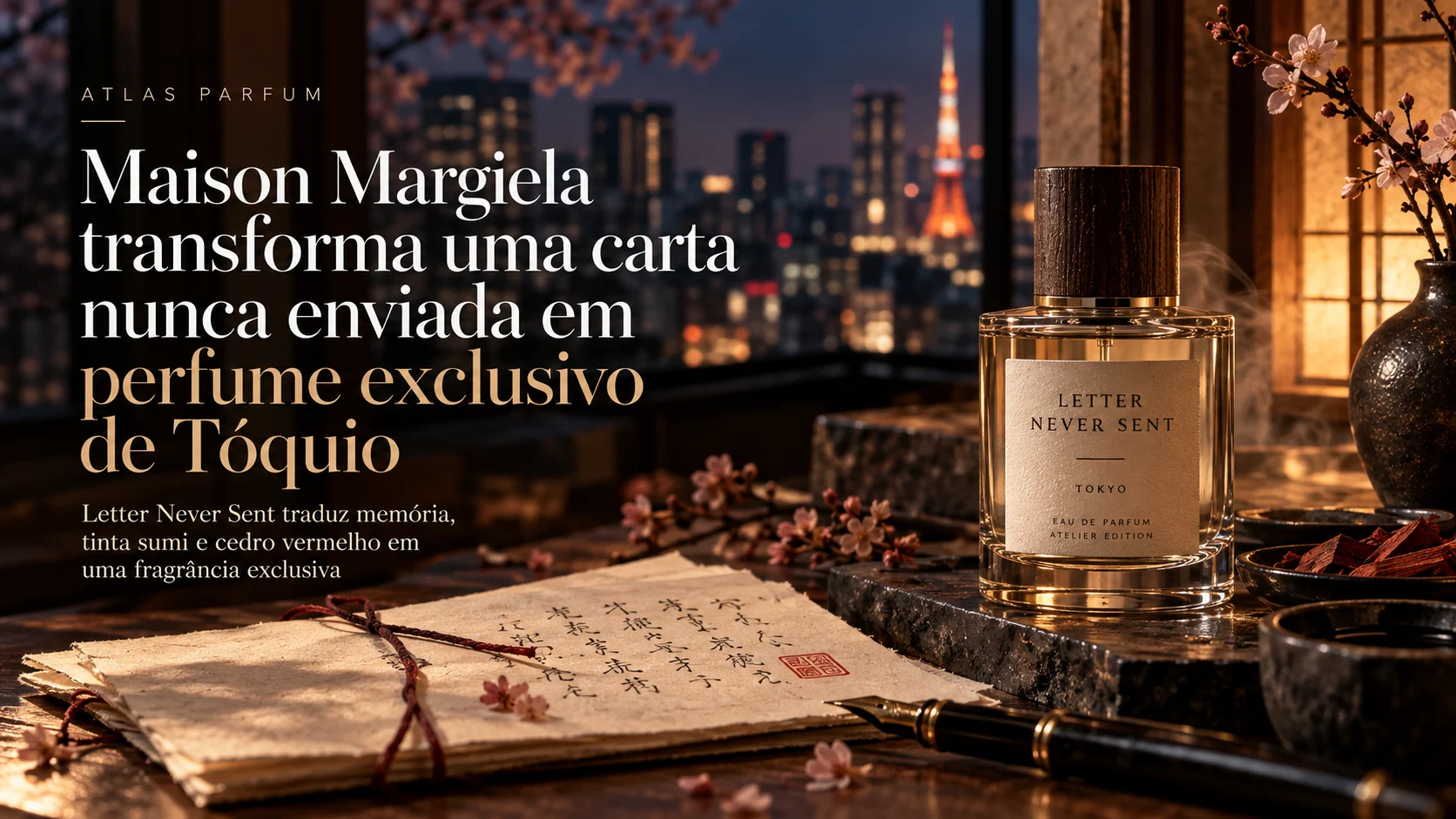
A letter that never reached its recipient can continue to exist as a memory. Maison Margiela builds Replica Letter Never Sent around this simple — and emotionally powerful — idea, with the fragrance launched on October 1, 2026 exclusively at selected locations in Tokyo.
The creation expands the language of the Replica collection, known for turning places, situations and memories into olfactory compositions. This time, the brand does not begin with a beach, a library or a specific afternoon. It starts with something absent: words that were written but never sent.
The result is a woody, musky fragrance built around a sumi ink accord, red cedar and white musk — materials used to suggest ink, paper, wood and intimacy.
Tokyo, 1995
The official narrative places the memory in Tokyo in 1995, a period when digitalization was beginning to profoundly change how people wrote, stored and sent messages.
The concept works precisely with that moment of transition. A physical letter could be folded, stored, stained, forgotten in a drawer or found years later. A digital draft, on the other hand, can simply disappear.
Maison Margiela uses this material difference as narrative raw material. Rather than treating technology as the villain, the fragrance tries to recover the texture of the gesture: the pen touching the paper, the ink drying, and the silence between what was felt and what was never said.
The smell of ink as a starting point
The sumi ink accord is the composition’s most distinctive element. Sumi is the traditional ink used in Japanese calligraphy and painting, and its presence within the concept directly connects the perfume to the cultural references chosen for the project.
Translating “ink” into perfumery does not necessarily mean making the liquid smell like an open bottle of drawing ink. An accord can use mineral, smoky, woody or slightly metallic facets to construct the sensation of pigment and paper.
In the narrative of Letter Never Sent, this impression meets red cedar. The wood acts as a bridge between the dryness of the ink and the tactile feeling of paper. In the base, white musk softens the composition and introduces a clean, intimate, skin-like effect.
Maison Margiela itself associates the musk with the touch of high-quality paper and the lingering quality of a personal memory.
Replica works because it sells memories before notes
One reason the Replica collection has become so powerful is the way it presents fragrance. Consumers do not need to master olfactory families to understand “Jazz Club,” “By the Fireplace” or “Beach Walk.” The name already delivers a situation.
This turns notes and raw materials into narrative tools. The fragrance does not begin by asking whether the consumer likes cedar or musk; it asks whether the scene evokes something.
Letter Never Sent takes this logic into a more abstract territory. It is not a concrete universal memory, like a vacation by the sea. It is an emotional memory: the feeling of having kept words to yourself.
Why Tokyo?
Geographic exclusivity is an essential part of the launch. The fragrance was not presented simply as “inspired by Tokyo”; it is commercially tied to the city.
This creates two layers of value. The first is narrative: the composition gains cultural and urban context. The second is commercial: limited access turns the fragrance into an object of travel and collecting.
City exclusives are not new in perfumery, but they remain effective because they restore a sense of discovery to a physical product that global e-commerce often removes. When almost any launch can be purchased from anywhere, territorial exclusivity creates another reason to visit a city, a boutique or a specific address.
The campaign takes the letter into the streets
Maison Margiela also expanded the concept beyond the bottle. In the Japanese launch campaign, letters appeared in the urban space of Shibuya, inviting the public to think about feelings that were never expressed.
The activation is consistent with the central idea of the fragrance: turning something private into a collective experience. What begins as one person’s unsent letter becomes an open question to thousands of people moving through one of Tokyo’s busiest districts.
Perfume as a cultural object
Letter Never Sent points to an important direction in contemporary perfumery. In a market saturated with launches, a list of notes is no longer enough to create differentiation. Houses need concepts that can exist across photography, video, retail, social media and physical experience.
That does not mean storytelling can replace a good composition. It means perfume now competes as a cultural object as well.
In that sense, Maison Margiela has an advantage: Replica was built around exactly this logic. The deliberately simple bottle and almost documentary-style label leave the spotlight on the memory being described.
More than nostalgia
The Japanese communication itself emphasizes that Letter Never Sent is not intended to be merely a nostalgic exercise about handwritten correspondence. The idea is to revisit unfinished feelings and turn them into something present.
That difference matters. Pure nostalgia looks backward. The fragrance’s proposal tries to use the past as material for interpreting the present.
And perhaps that is exactly why an unsent letter works so well as an olfactory concept: perfume is also invisible, remains for a while and disappears — yet it can continue to exist in memory long after it has left the skin.