






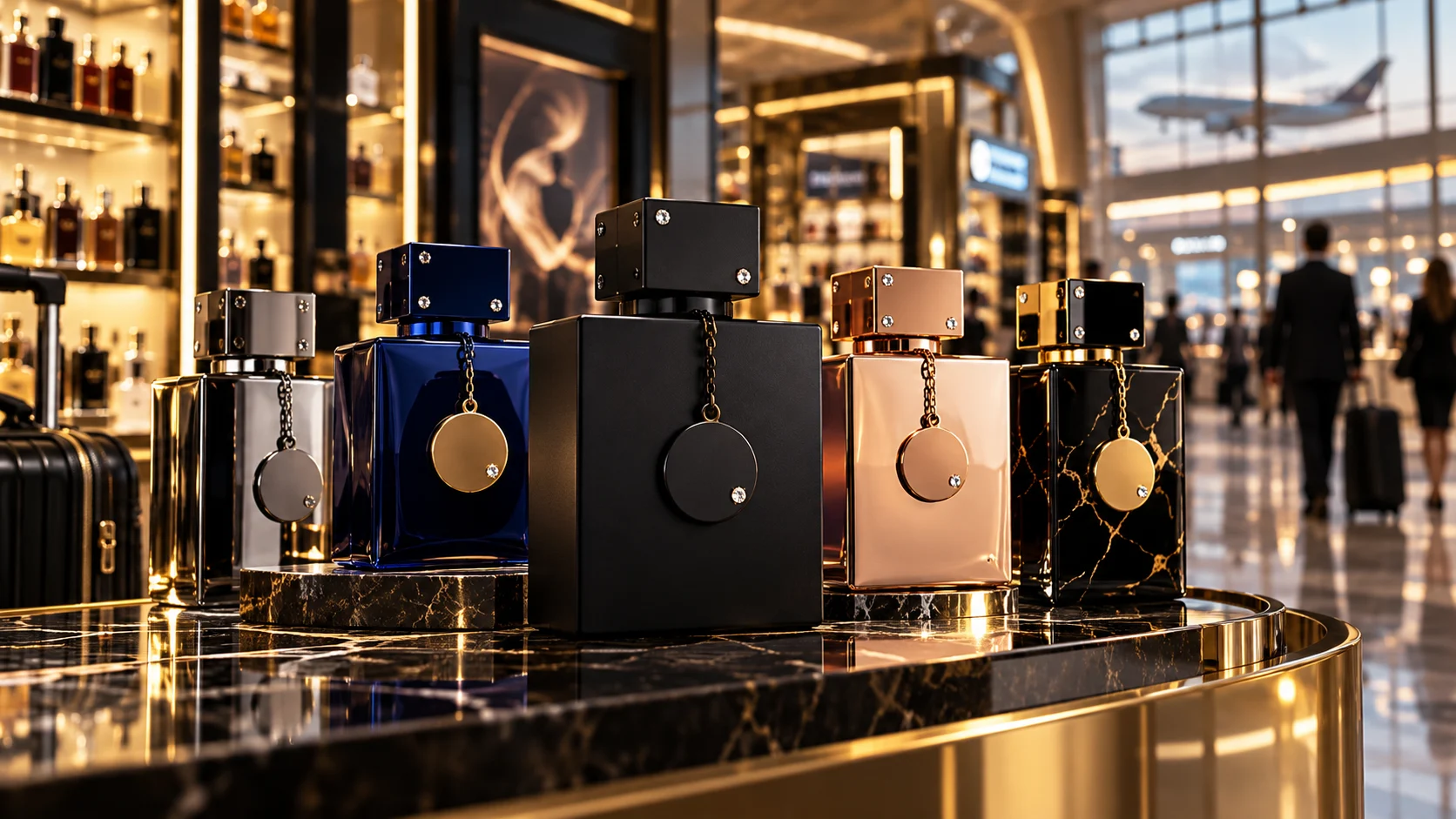
Armaf arrived at the 2026 TFWA World Exhibition & Conference in Cannes with a message that goes far beyond new perfumes: the Dubai brand wants to turn its international success into a global fragrance platform, with products, formats and collaborations designed for different audiences — including consumers shopping in airports and duty-free environments.
Among the new products presented were Club de Nuit Intense Overdose, a collaboration with Indian actor John Abraham; wider distribution of Club de Nuit Elite; and the upcoming SHK 5 and SHK 6, connected with the project involving Dubai-based actor, influencer and philanthropist Saud Al-Kaabi.
Individually, each launch could be treated as another portfolio extension. Together, however, they reveal a broader strategy: Armaf is learning how to turn recognized properties into brand ecosystems.
Club de Nuit is no longer just one perfume
Club de Nuit Intense Man has become one of the most recognizable names in contemporary Arab perfumery. According to Evarist Rego, Director of Strategy and Business Development at Sterling Perfumes, the product sells approximately one bottle per second globally — a figure shared with TRBusiness during the Cannes fair.
When a fragrance reaches this level of recognition, the natural temptation is to exploit the name. The risk is doing so excessively and diluting the original identity.
Club de Nuit Intense Overdose enters precisely within that balance.
The new interpretation maintains a direct connection with Intense Man, but adds a more gourmand direction, presented by the company as an update aimed particularly at younger consumers.
The move matters because it shows Armaf treating Club de Nuit as a brand property, not merely as an isolated bestseller.
Why gourmand now?
The growth of sweet, creamy and edible-smelling perfumes is not unique to Armaf. Gourmand has become one of the most important languages in recent perfumery, crossing niche, designer, body care and Arab fragrance.
By introducing this facet into a name consumers already know, the brand reduces part of the risk usually associated with an entirely new launch.
The consumer recognizes Club de Nuit but finds a different proposition.
It is a common strategy in major designer franchises and one that is increasingly visible among Gulf houses as well.
Club de Nuit Elite tries another route
If Overdose seeks to modernize a familiar signature through gourmand effects, Club de Nuit Elite moves in another direction.
The fragrance has been described as fresh, green and unisex, built around vetiver. After a soft launch, the brand is preparing wider distribution.
The simultaneous existence of Overdose and Elite helps explain the line’s expansion: Club de Nuit does not have to represent only one olfactory profile.
Armaf can use the recognition of the name to test different territories and audiences.
SHK turns collaboration into a collection
Another important front is the Armaf SHK collection, developed with Saud Al-Kaabi.
SHK 5 and SHK 6 are expected to reach stores in November 2026. SHK 5, presented in Cannes, places tuberose at the center of the composition and will be offered in several formats, including 100 ml, 60 ml, a travel set and a discovery set.
The choice of formats is as relevant as the fragrance itself.
Discovery sets and smaller presentations lower the barrier to experimentation, facilitate travel purchases and allow consumers to explore a collection before investing in a full-size bottle.
Dubai becomes part of the narrative
According to Rego, the SHK concept also grows out of Dubai’s multicultural character. Saud Al-Kaabi grew up in a city where hundreds of nationalities coexist and brought to the project references to ingredients discovered through travel and international experiences.
This narrative is meaningful because Dubai stops functioning merely as a corporate address.
The city becomes a creative argument: a meeting point between cultures capable of producing equally hybrid perfumery.
This positioning may become one of the great advantages of Emirati houses. Instead of trying to reproduce Paris, they can turn the Gulf’s own diversity into identity.
Creators enter creation, not only promotion
The presence of John Abraham and Saud Al-Kaabi points to another movement worth watching.
For years, celebrities were used mainly as campaign faces or licensors. Public figures are now appearing more often as part of the narrative of creation and product development.
This also brings perfumery closer to the creator economy.
When a creator participates in the concept, the audience already exists before launch. The brand does not have to build all initial interest by itself.
The challenge is ensuring that the collaboration has enough coherence to survive beyond the reach of that personality.
Travel retail is no longer only a distribution channel
Perhaps the most strategic part of the Cannes presentation sits outside the perfumes themselves.
Armaf entered travel retail around three years ago and is now beginning to develop formats specifically for this environment.
According to TRBusiness, the company is working with refillable Club de Nuit Intense Man versions, travel pouches, miniatures, discovery sets and even a Malika hand cream developed specifically for the channel.
More importantly, Armaf is studying products that will not be offered through conventional distribution.
Why does exclusivity work in airports?
Duty free has its own consumer behavior. Travelers compare international brands and often look for something they cannot easily find in their home city.
Exclusive products give the retailer an additional reason to purchase.
For the brand, the airport also functions as a global showcase. Someone who might never encounter Armaf in a local perfumery can discover the house during an international connection.
This turns travel retail into a brand-building tool, not merely a source of revenue.
Presence in 140 countries changes the scale of the conversation
Armaf says it is present in approximately 140 countries. That scale requires looking at the company differently.
We are no longer talking simply about an “Arab brand that went viral.” We are talking about an international operation that needs to coordinate product, distribution, price, communication and positioning across very different cultures.
The growth of Emirati houses is often explained only through competitive prices and social media. Those factors matter, but they are not enough to sustain presence in 140 markets.
There is industrial and commercial infrastructure behind the growth.
What is Armaf trying to become?
This may be the most interesting question.
Armaf’s first phase was marked by rapid expansion and the recognition of names such as Club de Nuit. The next appears to involve building franchises, more sophisticated collaborations, exclusive formats and presence in global channels.
It is an evolution similar to what major designer brands have gone through: first sell one successful perfume, then build a universe capable of generating new interpretations, lines and experiences.
If Armaf can make this transition without losing the value proposition that helped popularize it, the brand may occupy an even larger space outside the Middle East.
For Atlas Parfum, it is precisely this passage — from popular Arab brand to global brand originating in Dubai — that deserves to be followed.