






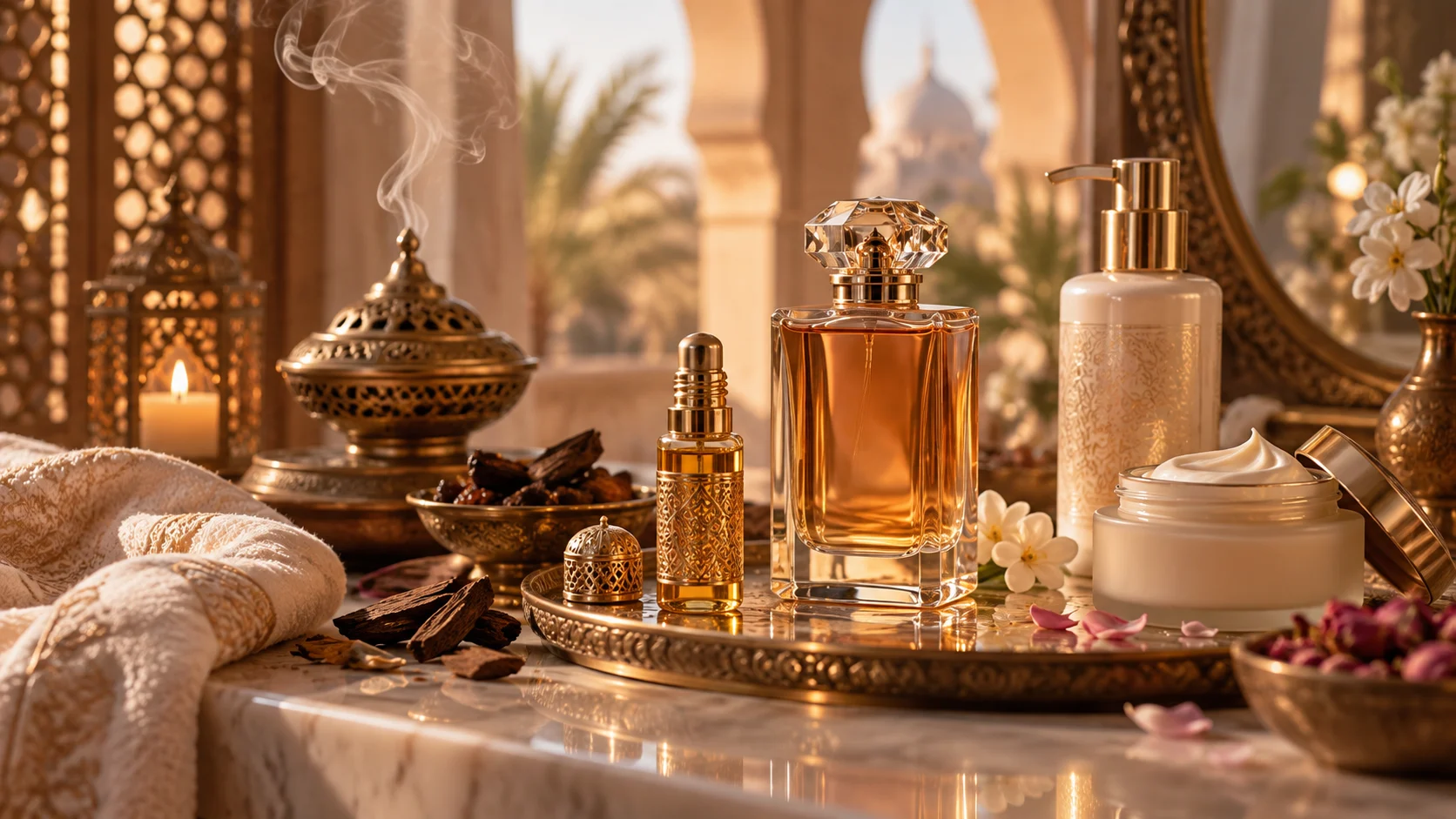
Arab perfumery has always treated fragrance as something bigger than spraying a single bottle. Oils, bakhoor, oud, creams and different fragrances can be layered until they create a personal signature. Hamidi is turning that tradition into an organized commercial proposition for contemporary consumers.
The concept is called Scent Rituals and will be presented by the Dubai house during Beautyworld Dubai 2026. Instead of treating perfume as the final step in a routine, Hamidi builds a system that begins in the shower, moves through skin care, uses perfume oil and 0% alcohol Eau de Parfum, and ends in the surrounding space.
The idea is interesting for more than the launch itself. It shows how Middle Eastern houses are beginning to export something beyond olfactory notes: a different way of using fragrance.
Four stages to build a signature
In the official presentation of Scent Rituals, Hamidi organizes the process into four moments.
Prep: bath and body products prepare the skin and introduce the first olfactory layer.
Base: concentrated perfume oils are applied close to the skin.
Top: a 0% alcohol Eau de Parfum adds another dimension to the construction.
Space: home fragrances carry the signature into the environment.
This organization turns a traditional practice into language that is simple and commercially understandable.
Layering did not begin on TikTok
In recent years, layering has gained enormous visibility on social media. Creators teach combinations, consumers mix perfumes and brands launch products described as “layerable.”
But the practice of building scent through layers predates digital platforms by generations.
Across different Middle Eastern cultures, perfumed oils, incense, oud and alcoholic or non-alcoholic fragrances have long been used in sequence.
What is new is the way this tradition is being packaged for a global beauty and wellness market.
Perfume enters the self-care routine
Hamidi describes its evolution as a move from a fragrance-focused brand toward a broader beauty and wellness proposition.
This brings perfume closer to skincare and body care.
Instead of asking only “which fragrance do you wear?”, the brand tries to occupy several moments: shower, hydration, oil application, spray and home scenting.
Commercially, this multiplies touchpoints.
A consumer who enjoys one signature can buy several products from the same family instead of only one bottle.
Hydrated skin as part of the ritual
The brand also uses an idea familiar to fragrance wearers: hydrated skin can help some scents remain perceptible for longer and provide a different surface for application.
By placing body products at the beginning of the ritual, Hamidi connects functional benefit with layering.
This integration is part of a broader movement sometimes described in the industry as the skinification of fragrance — the convergence of skincare language and perfumery.
0% alcohol: positioning and context
Alcohol-free fragrances are a central part of Hamidi’s identity.
In its Beautyworld presentation material, the company associates these formulas with skin comfort and a conscious-beauty proposition.
An editorial distinction is important here: the absence of alcohol does not automatically make a fragrance “better,” “safer” or suitable for every skin type. Safety depends on the complete formula, concentration, raw materials and individual sensitivity.
What makes the trend relevant is something else: it expands the formats available and serves consumers seeking experiences different from traditional alcoholic Eau de Parfum.
Perfume oils gain new international visibility
Perfume oil is a historic format in different Eastern markets, but for many Western consumers it still functions as an alternative or discovery.
It is usually applied locally and can create a more intimate, skin-close experience.
By positioning oil as the “base” and spray as the “top,” Hamidi teaches consumers to use two complementary products rather than treating them as competitors.
This commercial education matters.
When a brand introduces a less familiar format, explaining how to use it increases the chances of adoption.
From skin to home
The fourth stage — Space — expands the concept even further.
The same person who builds a personal fragrance signature can carry that scent into the home through ambient fragrance.
This reflects the blurring of boundaries between personal and home perfumery.
NEST takes a home fragrance to the skin. Le Labo turns a diffuser into a design object. Hamidi goes across the full journey and organizes body and home within one ritual.
Why does this matter to the industry?
Because it increases the consumer’s so-called lifetime value.
A brand that sells only perfume competes for one purchase. A brand that sells a ritual can occupy several categories: shower gel, cream, oil, Eau de Parfum and diffuser.
But there is one condition: the products need to work as a system without feeling like forced upselling.
The consumer needs to perceive benefit and pleasure in each layer.
Local tradition becomes a global advantage
Hamidi says it has more than 20 years of history and a presence in around 65 countries.
By internationalizing Scent Rituals, the company can leverage something Western brands would find difficult to reproduce with the same legitimacy: a historic cultural relationship with layering and perfume oils.
This shows an important shift in the strategy of Arab fragrance houses.
For years, many grew internationally by being compared with Western perfumes. Now, some are beginning to realize that their greatest advantage may lie precisely in what they do differently.
From product to behavior
This is the most interesting dimension of Scent Rituals.
Products can be copied. A shower gel, an oil or a diffuser are not innovations in isolation.
The value lies in teaching a behavior.
If consumers adopt the idea of building fragrance through four stages, Hamidi will not simply be selling a collection. It will be helping to create a habit.
What to watch after Beautyworld
The fair will show which fragrances and formats actually make up the brand’s new phase and how the concept is presented to international distributors.
It will also be important to see whether Scent Rituals remains a campaign or starts to permanently organize the portfolio.
If the second scenario happens, Hamidi may offer a relevant example of how an Arab house can turn cultural heritage into a global beauty platform.
For Atlas Parfum, this is exactly the kind of movement worth following: not only “which perfume was launched,” but how the industry is changing the way fragrance is created, sold and used.