






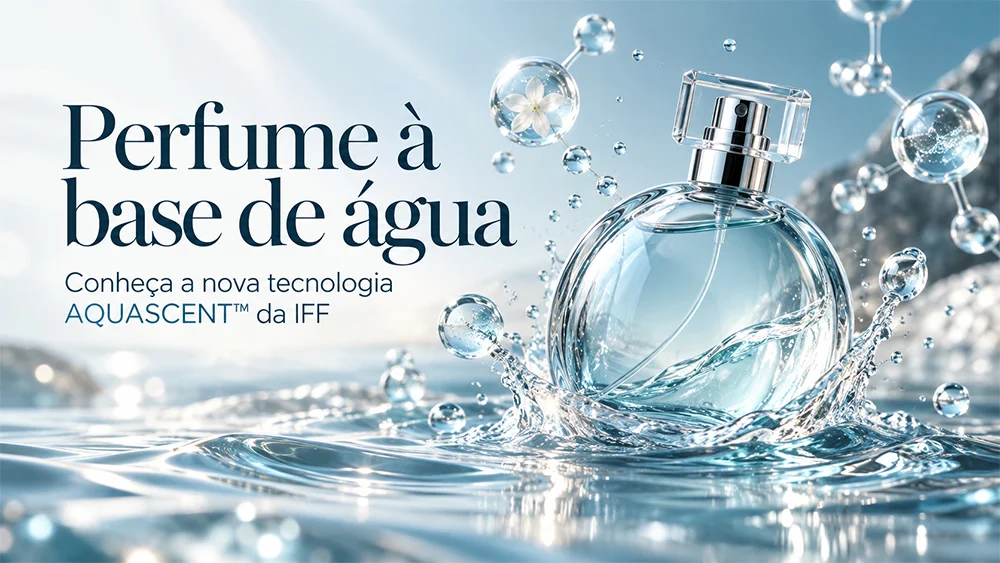
Is alcohol-free perfume the next big shift in perfumery? IFF thinks so
The new AQUASCENT technology makes it possible to create water-based fragrances with aromatic-compound concentrations of up to 25% — and could help reshape a formula that has dominated fine fragrance for decades.
For a long time, some rules of perfumery seemed almost untouchable.
One of them was inside the bottle itself.
Alcohol, fragrance concentrate and a carefully balanced formula formed the foundation of countless perfumes we know. Eau de Cologne, Eau de Toilette, Eau de Parfum, Parfum: concentrations, raw materials and olfactory construction changed, but alcohol remained a central part of much of fine perfumery.
Now, one of the world’s largest fragrance companies is trying to broaden those possibilities.
International Flavors & Fragrances (IFF) has introduced AQUASCENT, a technology designed to enable water-based fine fragrances with performance, visual clarity and concentrations that begin to approach territory traditionally occupied by alcohol-based perfumes.
And that may be far more important than simply removing alcohol from a fragrance.
So what exactly is AQUASCENT?
Officially presented by IFF on September 30, 2026, AQUASCENT is a vegan, water-based carrier developed for fine fragrance.
According to the company, the technology can work with fragrance-concentrate loads between 10% and 25% while maintaining a clear appearance. In many comparable systems, IFF says, that limit is around 15%.
That number is particularly interesting.
One of the challenges in developing water-based perfumes is combining water and aromatic materials without creating cloudiness, instability or compromising the experience expected from a fine fragrance.
Oil and water, after all, are rarely natural partners.
AQUASCENT is designed precisely to overcome that technological limitation.
It is not simply about replacing alcohol with water
This is where the story becomes more interesting.
It would be easy to summarize the news as “IFF creates alcohol-free perfume.”
But that would reduce what is actually happening.
The technology was developed within IFF’s Science of Performance platform, an initiative dedicated to studying and controlling how fragrances are delivered and perceived over time. The company also says the formulation contains no intentionally added ethanol, preservatives or silicone and has documented skin-hydration properties.
In other words, the goal does not appear to be merely reproducing an alcohol-based fragrance with a different solvent.
We are talking about the possibility of creating a different wearing experience.
Less of an alcoholic sensation at application.
A formula that may feel more comfortable on skin.
New textures. New formats. And above all, a new way of thinking about the ritual of wearing fragrance.
Consumers are already searching for it
Technologies do not transform markets simply because they are interesting in the laboratory.
They need to meet desire outside it.
And there are signs that this interest already exists.
Digital-monitoring data released by IFF indicate that global Google searches for “water-based perfumes” increased 18% year-to-date, while related content surpassed 15 million views on TikTok.
These figures come from the company itself and should be viewed in that context, but they point to something already visible across different areas of beauty: consumers are increasingly willing to experiment with formats that move beyond traditional perfume.
Hair mists. – Body mists. – Perfume oils. – Solid perfumes. – Bi-phase formulas. – Fragrances designed for layering.
And now, with growing momentum, water-based perfumes.
Perfume no longer has to exist only in the familiar Eau de Parfum bottle.
Does this mean alcohol will disappear?
Probably not — and perhaps that is not even the most interesting question.
Alcohol has characteristics that helped establish it in modern perfumery. It evaporates quickly, supports fragrance diffusion and directly affects how we perceive the opening of many compositions.
There is also an enormous body of technical and creative knowledge built around it.
So imagining a complete replacement would be premature.
The more likely movement is another one: the multiplication of fragrance formats.
Just as Eau de Toilette, Eau de Parfum, Extrait, perfume oil and body mist can coexist, water-based fragrances may form another relevant category within that ecosystem.
And when a major ingredient and technology supplier such as IFF invests in this direction, the discussion stops being merely experimental.
It begins to gain industrial scale.
There is also a logistics question
AQUASCENT introduces another detail that is less glamorous than a new olfactory accord, but extremely important to the industry.
Transport. According to IFF, the technology can be supplied in concentrated form so that brands add water only during the final production stage. That means some of the water present in the finished product does not need to travel long distances by truck, ship or aircraft.
Less transported weight can mean lower resource consumption and a reduction in emissions associated with logistics.
In a globalized industry where ingredients, concentrates, packaging and finished products frequently cross continents, this efficiency can carry economic weight beyond the environmental argument.
A quiet change may be happening inside the bottle
Some of the biggest transformations in perfumery did not begin with spectacular campaigns.
They began with a new molecule.
A new extraction method.
A previously unavailable raw material.
A technology capable of doing something that had once been difficult.
Then perfumers began experimenting.
Brands began launching products.
And consumers began discovering new ways to experience fragrance.
AQUASCENT still has to prove its impact in the real market. Announcing a technology does not automatically mean consumers will abandon traditional formulas or that water-based perfumes will suddenly flood shelves.
But there is one important difference this time.
Demand appears to be emerging at the same moment the technology is advancing.
What could happen next?
Perhaps the most interesting question is who will use this technology first.
Major houses? Niche brands? Lines aimed at consumers who avoid alcohol?
Summer perfumes?
Fragrances for Middle Eastern markets?
New hybrid concepts between fragrance and skincare?
These are possibilities — not confirmed announcements — and that is exactly why the subject deserves attention.
If the technology delivers at scale what it promises in the laboratory, perfumers could gain a new creative platform.
And consumers may begin to find something on shelves that still sounds unusual:
a high-concentration fragrance whose main base is not alcohol, but water. Perhaps the future of perfumery is not about replacing what already exists.
Perhaps it is simply about increasing the number of ways we can wear, smell and experience fragrance.
And that change may already have begun.