



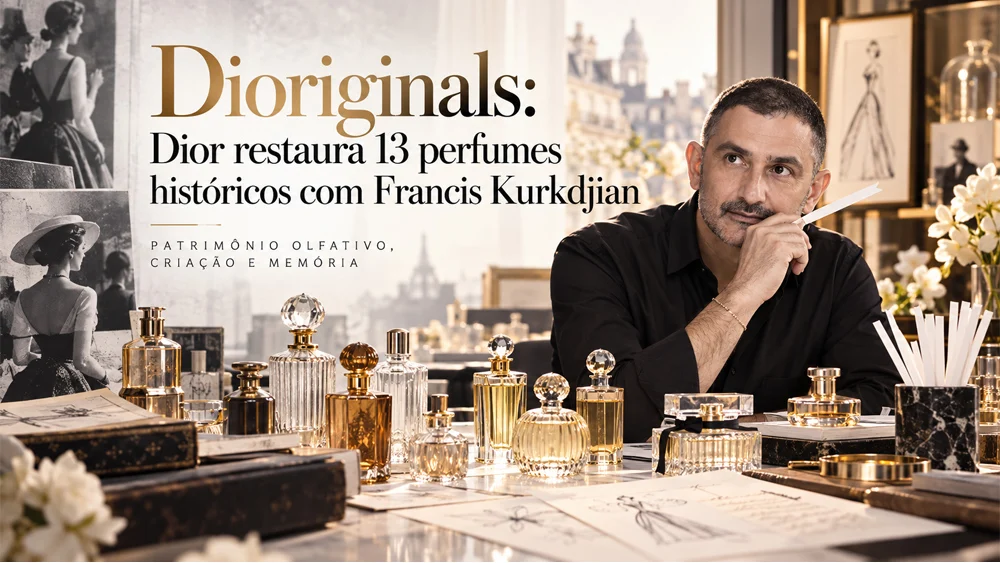
Dioriginals: Francis Kurkdjian opens Dior’s archives to bring 13 historic perfumes back to life
Dior brings together nearly eight decades of olfactory history in a collection of 13 restored fragrances. More than simply relaunching old perfumes, Francis Kurkdjian raises a fascinating question: can a perfume be preserved forever?
A dress can spend decades inside an archive. A piece of jewelry can be restored. A painting can receive the meticulous work of conservators to recover colors faded by time.
But what about a perfume?
How do you preserve something that does not exist only inside a bottle, but depends on natural raw materials, suppliers, regulations, production techniques and molecules that may disappear or cease to be permitted? That is precisely the problem Dior decided to confront.
In 2026, the maison presented Dioriginals, a collection bringing together 13 fragrances spanning almost 80 years of the house’s olfactory history, restored under the direction of Francis Kurkdjian, Dior’s Perfume Creation Director.
And perhaps the most important word here is not “relaunch.” It is restoration.
Perfumes age too
There is an experience many fragrance lovers know very well. You encounter again a perfume you wore 10, 20 or 30 years ago.
The name is the same. The bottle looks familiar.
But something has changed.
Sometimes the opening feels different.
The base is cleaner.
The animalic character has disappeared.
The texture feels lighter.
The perfume that exists in memory no longer corresponds exactly to the perfume coming out of the bottle.
This does not necessarily happen because a brand deliberately decided to change its creation. Perfumes are extremely complex organisms.
Natural raw materials vary according to harvests, climate, terroir and availability. Suppliers change. Some substances cease to exist commercially. Others become subject to regulatory restrictions or bans.
Small substitutions accumulated over decades can slowly alter the balance of a composition. That is exactly the phenomenon at the heart of the Dioriginals project.
Francis Kurkdjian takes on the role of restorer
Francis Kurkdjian could simply have reinterpreted these perfumes. He chose another path.
Dior describes his work as an attempt to recover the luminosity, proportions and character of the original compositions using the resources available today.
The comparison chosen by the perfumer himself is revealing.
For him, caring for a historic fragrance is close to the work done on a delicate work of art: preserving what constitutes its identity despite the passage of time. It is an important distinction.
Reinterpreting would mean asking:
“How would I make this perfume today?”
Restoring means asking:
“How can today’s perfume reconnect with what it once was?”
These are completely different propositions.
And for a maison with almost eight decades of olfactory heritage, that distinction matters.
13 perfumes. Almost 80 years of Dior.
The collection crosses different moments in the house’s history.
The Dioriginals include:
Diorama — 1949
Eau Fraîche — 1955
Diorissimo — 1956
Diorling — 1963
Diorella — 1972
Dioressence — 1979
Jules — 1980
Dune — 1991
Dolce Vita — 1995
Dune Pour Homme — 1997
Higher — 2001
Forever and Ever — 2002
Higher Energy — 2003
The range is fascinating.
Dior did not select only extremely old perfumes.
There are creations from the 1990s and even the 2000s.
That suggests an interesting interpretation of what a major maison considers heritage.
A perfume does not need to be 70 years old before it begins to become part of history.
Edmond Roudnitska returns to the center of the conversation
One name appears repeatedly in the early chapters of this collection:
Edmond Roudnitska.
Diorama, Eau Fraîche, Diorissimo and Diorella are among his most important contributions to the house.
And that makes Dioriginals particularly interesting for anyone who wants to understand the evolution of modern perfumery.
Roudnitska was not simply making perfumes.
He helped build a language.
Diorissimo
Created in 1956, Diorissimo transformed lily of the valley — the famous muguet, a flower associated with luck and beloved by Christian Dior — into one of the maison’s great floral themes.
Dior itself now classifies Diorissimo as one of the masterpieces of world perfumery.
Eau Fraîche
One year earlier, in 1955, Roudnitska had created Eau Fraîche.
According to Dior, it was also a fragrance worn by Christian Dior himself.
Diorella
Then came Diorella in 1972.
The creation works with a floral chypre structure featuring jasmine, violet, fruity nuances, vetiver and oakmoss, along with a character the maison itself describes as representative of the free spirit of the 1970s.
Placed side by side, these perfumes stop being merely products.
They begin to function as chapters in a story.
And then comes Dune
If Roudnitska’s creations represent part of Dior’s historical foundations, Dune represents another moment. Originally launched in 1991, the fragrance belongs to a completely different generation.
There is something interesting about Dune’s presence in Dioriginals. Many current consumers discovered the brand through perfumes released long after the great classics of the 1940s, 1950s and 1960s. For them, fragrances such as Dune and Dolce Vita may produce exactly the same emotional effect that Diorissimo creates for another generation.
This is where heritage and memory begin to merge. Because the history of perfumery does not exist only in brand archives. It also exists on the skin of the people who wore these fragrances.
The great problem of reformulation
Dioriginals also touches one of the most controversial subjects among collectors.
Reformulations.
Few phrases generate as much debate in fragrance communities as:
“The old version was better.”
There is a great deal of nostalgia in that statement. But there is also a technical reality.
A formula created decades ago may contain ingredients whose use is now restricted, raw materials that have changed supplier or substances that are simply no longer available in the same way.
Specialist press reports that Kurkdjian worked for years on this problem, trying to reconstruct the original balance of the compositions within today’s regulatory and technical conditions.
It is important to make a distinction. Dioriginals does not necessarily mean putting into a 2026 bottle exactly everything that existed in 1956. That could be technically or legally impossible.
The work is more delicate:
reconstructing the olfactory effect.
It is almost like restoring an old photograph when some of the original pigments no longer exist. The goal is not to copy every isolated element. It is to recover the image.
Even the bottle returned to the archives
The restoration does not end with the formula. Dioriginals are presented in the Ovale bottle, a design created in 1948 and associated with the early years of Parfums Christian Dior. The contemporary version keeps the historic silhouette and adds a textured label, a ridged metal frame and the CD monogram. Visually, it is a smart decision.
These are not simply 13 old perfumes placed back on shelves. They now visually belong to the same library. A kind of Dior olfactory archive in bottles.
Luxury is discovering the value of its archives
There is also an interesting commercial reading. For years, the fragrance industry was driven mainly by novelty.
New perfume. New flanker. New concentration. New campaign. New celebrity. New hero ingredient.
But historic houses possess an asset that newly created brands simply cannot buy:
time.
A company can invest billions in marketing. It cannot retroactively manufacture a history that began in 1949. By turning historic perfumes into an organized collection, Dior converts heritage into a contemporary experience.
And that may signal something bigger.
Perhaps we are entering a phase in which major maisons will begin looking at their olfactory archives with the same care they already devote to haute-couture archives.
Perfume as cultural heritage
There is something even larger behind this discussion. When a perfume disappears, what exactly is lost?
A formula? A commercial product? Or a small part of the culture of a particular era?
Perfumes record tastes.
They record technologies.
They record available ingredients.
They record social behavior.
They record different ideas of masculinity, femininity, sensuality, elegance and luxury. Smelling a great composition from 1950 is, in some way, experiencing part of that period through scent. Few other art forms offer that possibility.
We cannot hear a garment. – We cannot taste a painting. – But we can smell a perfume.
Dioriginals could change the industry’s relationship with its classics
Perhaps the project’s greatest merit does not lie in determining whether each new version is absolutely identical to the first formula. That debate will certainly happen among collectors.
And it is valid. The more relevant point is another one.
One of the world’s largest luxury houses is publicly saying that historic perfumes need to be preserved, studied and restored. That changes what these products mean.
They stop being merely old references that remain in the catalog while they continue to sell. They begin to be treated as heritage. And there is something especially beautiful in that idea. In an industry obsessed with the next launch, Francis Kurkdjian decided to look backward.
Not to live on nostalgia. But to ask what still deserves to be carried with us into the future. Perhaps some of the most interesting perfumes of 2026 were not created in 2026. Perhaps they began to be written almost eighty years ago.
DIORIGINALS — QUICK GUIDE
Collection: Dioriginals
Maison: Dior
Restoration direction: Francis Kurkdjian
Number: 13 fragrances
Historical period represented: 1949–2003
Concentration presented by Dior: Eau de Toilette
Families organized by the maison: floral, chypre and woody
Presentation: Ovale bottle inspired by the historic 1948 design.