






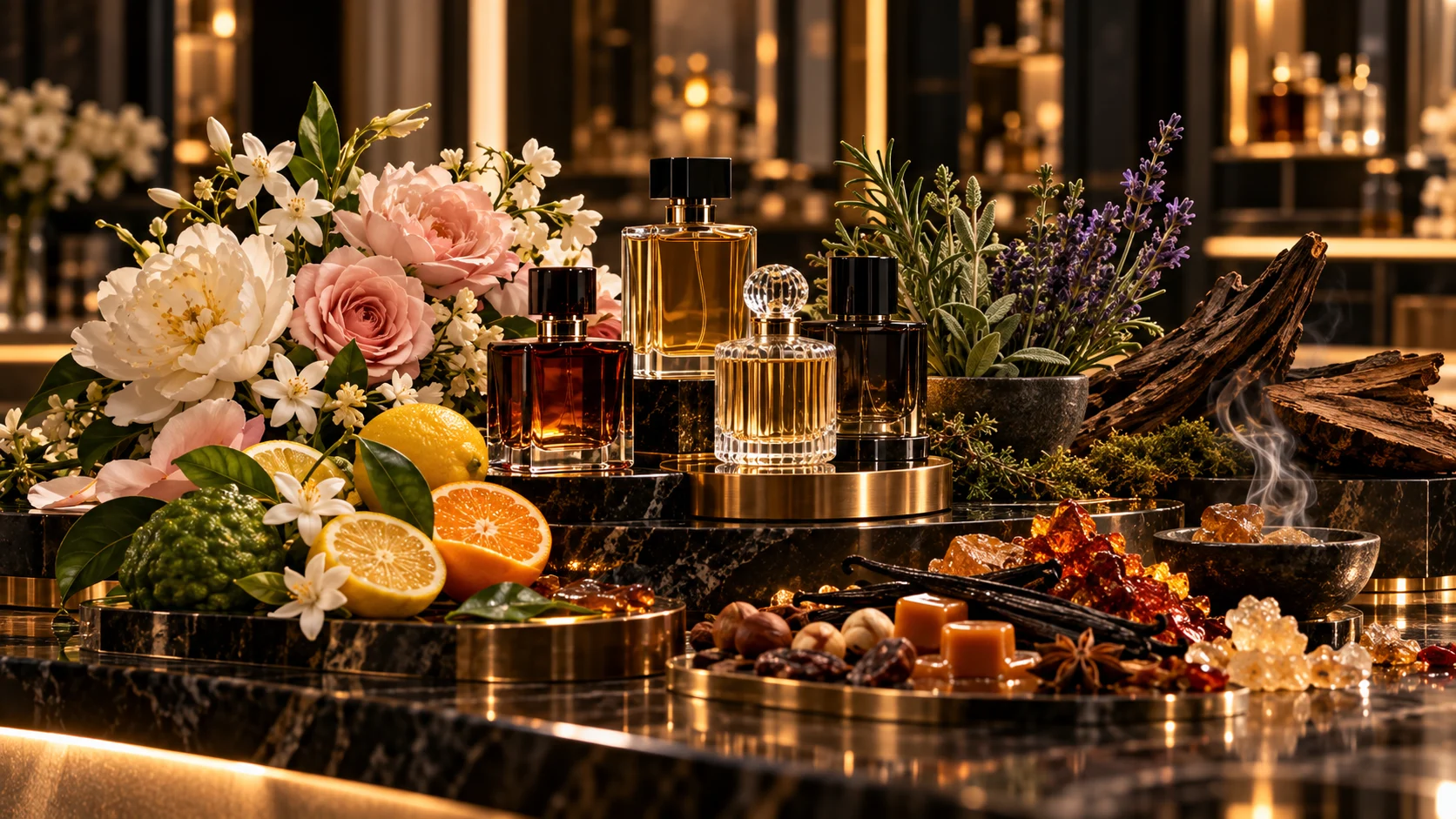
Olfactory families are a way of organizing perfumes according to their dominant scent and structural characteristics. They work like a map: helping people compare fragrances, understand preferences and discover new directions within perfumery.
Floral
The floral family includes fragrances centered on flowers. Rose, jasmine, tuberose, iris, orange blossom and ylang-ylang appear frequently. A floral can be delicate and transparent or intense, creamy and opulent.
Citrus
Citrus fragrances explore materials such as bergamot, lemon, mandarin, orange, grapefruit and other luminous effects. They usually convey freshness and energy, although they can be combined with woods, flowers, herbs or musk for greater depth.
Woody
Woods such as cedar, sandalwood and vetiver help create dry, creamy, earthy or elegant structures. Woody perfumes can be minimalist or intense depending on combinations with spices, amber, leather and resins.
Aromatic
The aromatic family often works with herbs and fresh-feeling materials such as lavender, rosemary, sage and green elements. It is common in compositions designed to suggest cleanliness, energy or nature.
Amber
The term amber describes warm, enveloping constructions, often built from resins, vanilla, spices, woods and balsamic materials. It can range from sweet and comforting to dark and sophisticated.
Gourmand
Gourmand perfumes create edible or dessert-like references. Vanilla, caramel, chocolate, coffee, praline, sugared fruits and lactonic effects are common. The family has gained enormous space in modern perfumery.
Chypre
Chypre structures traditionally combine a contrast between freshness, flowers and a drier, earthier or mossy base. Over time, the style has gained countless modern reinterpretations.
Fougère
Fougère is a classic structure associated with lavender, aromatic elements and a dry, mossy base. It is an important language in fragrance history and continues to be reinterpreted.
Leather
Leather fragrances can evoke soft suede, polished leather, smoke, wood or more animalic effects. They are often combined with flowers, spices, fruits and woods.
Aquatic and marine
These compositions explore sensations of water, air, salt, breeze and mineral freshness. They do not always rely on natural ingredients that literally smell like the ocean; often the effect is created through molecular constructions.
Fruity
Red fruits, peach, pear, apple, mango, pineapple and many other references appear in fruity perfumes. Depending on the base, the result can be fresh, floral, tropical, creamy or gourmand.
A fragrance can belong to more than one family
Classifications are not rigid borders. A perfume can be floral woody, citrus aromatic, fruity gourmand or amber spicy. Different systems may also classify the same fragrance in slightly different ways.
How Atlas handles international names
There is no single universal taxonomy used across all of perfumery. For this reason, Atlas Parfum maintains a canonical family name in Brazilian Portuguese and records historical or international names as equivalents. The wording used by the original source is also preserved whenever necessary.
Important: target audience is not part of the olfactory family. “Masculine,” “Feminine” and “Unisex” are separate data points. A fragrance can therefore be classified as Floral Amber while also having a Feminine target audience.
Historical and international equivalents
| Name found in other databases | Family used by Atlas | Type of relationship |
|---|---|---|
| Oriental | Amber | Historical alias |
| Oriental Floral / Floral Amber | Floral Amber | Historical / approximate |
| Oriental Vanilla / Amber Vanilla | Amber Vanilla | Historical / direct territory |
| Oriental Woody / Woody Amber | Woody Amber | Historical / approximate |
| Oriental Spicy | Amber Spicy | Historical alias |
| Oriental Fougère | Amber Fougère | Historical alias |
| Aromatic Aquatic | Aromatic Aquatic | Direct equivalent |
| Aromatic Fougère | Aromatic Fougère | Direct equivalent |
| Aromatic Fruity | Aromatic Fruity | Direct equivalent |
| Aromatic Green | Aromatic Green | Direct equivalent |
| Aromatic Spicy | Aromatic Spicy | Direct equivalent |
| Citrus Aromatic | Citrus Aromatic | Direct equivalent |
| Citrus Gourmand | Citrus Gourmand | Direct equivalent |
| Floral Aquatic | Floral Aquatic | Direct equivalent |
| Floral Fruity | Floral Fruity | Direct equivalent |
| Floral Fruity Gourmand | Floral Fruity Gourmand | Direct equivalent |
| Floral Green | Floral Green | Direct equivalent |
| Floral Woody Musk | Floral Woody Musk | Direct equivalent |
| Woody Aromatic | Woody Aromatic | Direct equivalent |
| Woody Aquatic | Woody Aquatic | Direct equivalent |
| Woody Spicy | Woody Spicy | Direct equivalent |
| Woody Chypre | Woody Chypre | Direct equivalent |
| Woody Floral Musk | Woody Floral Musk | Direct equivalent |
How Atlas interprets the Michael Edwards fragrance wheel
Some names on the Michael Edwards wheel correspond directly to Atlas families. Others represent neighboring territories, so they are treated as approximate equivalents rather than absolute synonyms.
| Michael Edwards | In Atlas | Treatment |
|---|---|---|
| Citrus | Citrus / Hesperidic | Direct |
| Green | Green | Direct |
| Water | Aquatic | Direct |
| Fruity | Fruity | Direct |
| Floral | Floral | Direct |
| Soft Floral | Floral | Approximate; original label is preserved |
| Floral Amber | Floral Amber | Approximate |
| Soft Amber | Amber | Approximate |
| Amber | Amber | Direct |
| Woody Amber | Woody Amber | Approximate |
| Woods | Woody | Direct |
| Mossy Woods | Woody Chypre | Approximate |
| Dry Woods | Woody | Approximate; “dry” is treated as a character/facet |
| Aromatic Fougère | Aromatic Fougère | Direct |
Use families as a starting point
If you realize that you enjoy woody perfumes, that already gives you a direction. From there, you can discover whether you prefer woods that are fresh, creamy, smoky or combined with spices. The same applies to any family.
At Atlas Parfum, families, notes, accords, facets and international equivalents work together to explain not only the name of a perfume, but the olfactory language behind it.