



The celebrity-fragrance market is entering a new phase. Instead of relying only on a famous name printed on the bottle, newer projects are moving closer to the structure of fine perfumery: recognized perfumers, major fragrance houses, fashion campaigns and olfactory concepts designed to last beyond the promotional cycle of an album or tour.
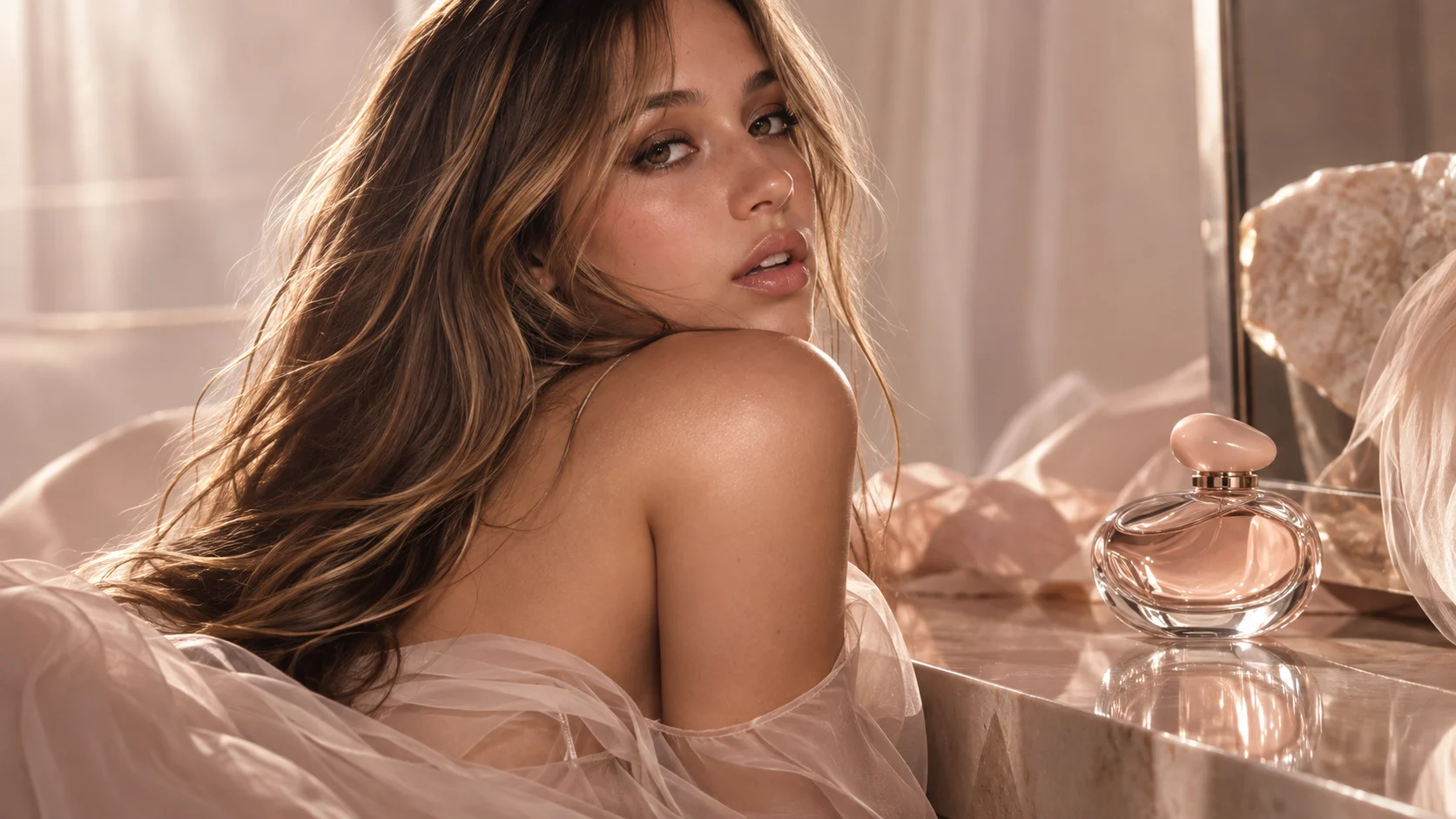
It is in this context that Tate McRae launches TATE 01 Eau de Parfum, her first fragrance, developed in partnership with Scent Beauty and Givaudan perfumers Adriana Medina and Antoine Maisondieu.
Introduced on October 1, 2026, the fragrance works with the idea of a “second skin”: something intimate, versatile and able to move with the body, temperature and personality.
What does TATE 01 smell like?
The composition opens with bergamot and clary sage. White florals, including orange blossom, appear in the heart, while the base combines moss, creamy tonka bean, sandalwood and soft woods.
The olfactory structure seeks to balance freshness and warmth. Rather than following the route of an overt gourmand or an exuberant floral, TATE 01 was designed to stay close to the skin and work as an everyday fragrance.
In an interview with People, McRae described her intention to create something classic and timeless that she herself would want to wear continuously. According to the singer, the fragrance was tested in her own routine for roughly a year before launch.
A fragrance built to move with the body
The “second skin” concept has been gaining strength in contemporary perfumery. Instead of announcing their presence from a distance, these creations aim to create intimacy and the impression of a personal smell.
That often involves woody, musky, ambery or transparent materials that interact subtly with the skin.
In TATE 01, the communication emphasizes precisely this adaptation to the wearer. The proposal is not to make the perfume disappear, but to avoid the impression of a rigid, overly constructed signature.
This positioning speaks directly to younger consumers who rotate fragrances, use layering and see perfume as an extension of mood and identity.
From the stage to perfume — without feeling like merchandise
Celebrity fragrances have always been tied to the public image of their creators. The challenge is preventing the product from feeling like merchandise.
TATE 01 tries to solve that by integrating fragrance into McRae’s artistic universe.
The campaign was photographed by Mario Sorrenti, a major name in fashion photography, and references 1990s supermodels. In an interview with Who What Wear, McRae connected the fragrance to the construction of her next musical era and to the duality between her personal identity and the character she inhabits on stage.
This connection between music, aesthetics and scent makes the perfume part of the artist’s world-building.
The new generation of celebrity fragrances
The celebrity-fragrance concept has gone through several cycles. In the 2000s, the segment produced numerous commercial hits, particularly around pop stars. Later, the category entered a period when many fragrance consumers began treating it as secondary.
The landscape is different now.
Celebrities have direct channels to millions of followers, can build their own brands and have access to top-tier suppliers and perfumers. That makes it possible to create projects that compete visually and olfactorily with traditional fragrance brands.
The question is no longer “can a singer launch a good perfume?” but “how much creative investment is behind the project?”
Givaudan changes how the launch is perceived
The presence of Adriana Medina and Antoine Maisondieu matters because it adds another layer of legitimacy to the product.
Givaudan is one of the world’s largest fragrance and ingredient houses. Projects developed within that structure have access to perfumers, laboratories, bases, molecules and industrial-scale research.
That does not automatically guarantee quality — perfume remains subjective — but it does show that development was treated as a fragrance project, not merely as name licensing.
Price and distribution also tell the story
TATE 01 debuted through channels connected directly to the artist and is expected to expand to Ulta Beauty beginning October 25.
This strategy combines an owned community with beauty retail at scale. First, the launch activates fans and more engaged consumers; then it enters an environment where it can be discovered by people who may not follow McRae as an artist.
It is an increasingly common model for brands born in digital culture.
Perfume as a piece of identity
Perhaps the most interesting aspect of TATE 01 is the way McRae speaks about fragrance. Instead of treating it as an accessory, she places it alongside music and fashion: tools capable of creating character, memory and emotional state.
That aligns with the way a younger generation consumes perfume. Fragrance no longer necessarily means “the same perfume for life.” It can change with occasion, mood, aesthetic or personal phase.
What TATE 01 represents for the market
It is too early to know whether TATE 01 will become a franchise or whether new fragrances will be added to the project. But the launch already illustrates a clear change.
Celebrity fragrance is no longer a category completely separate from the main perfumery conversation. When artists work with recognized perfumers, high-level campaigns and specialized distribution, their products need to be evaluated using the same criteria applied to other launches.
The famous name opens the door. The fragrance has to justify what happens next.